The Heart of Southern Kalaripayattu
Rooted in sage Agastya’s teachings, our southern style blends martial art with healing through siddha medicine, honoring centuries of Kerala tradition.
5/8/20242 min read
Thekkan Kalari / Adi Murai
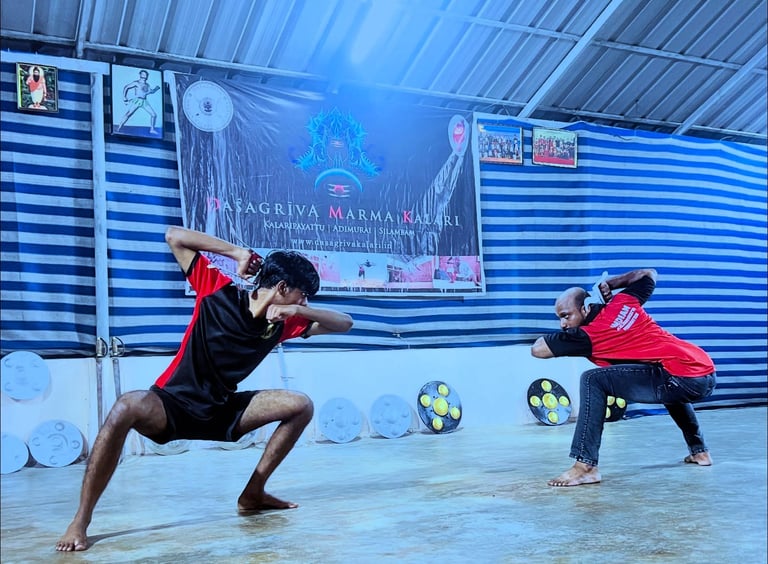
Thekkan Kalari, also known as 'Adi Thadai' in Tamil Marma Shastra, is the Southern Kalari and is the more secretive and subtle art, compared to the flamboyant and glamorous Vaddakan Kalari. Based on 'Adi Thadai', the Tamil Marma Shastra, Thekkan Kalari focuses on energy centres, channelizing them and pressure points, was believed to be developed by Sage Agastya. The first segment of Thekkan Kalari is Ottachoovadu, single leg movement in four directions, the next is Koottachoovadu, Double leg movements, third segment is Kaiporu or two man sparring, Naduvadi- long stick fight training and kuruvadi- short stick fight training, vettukathi- knife fighting and the last bit being Sword and Shield and Urumi fighting. Thattumarmachoovadu, or understanding the Marma pressure points is the main factor of Thekkan Kalari. This art form also emphasis on Stealth training or Chaadi as it is called. There are several Adi Thadai techniques that train an individual in stealth and ambush fighting. Thekkan Kalari or Adi Thadai focuses a lot on dissipating energy, and it is believed that with each strike, at a certain energy point, not only can one cause pain in the opponent, but also wrought changes emotional, mentally and physical.
The practitioners of Thekkan Kalari believe in balancing the Chakras, it is believed that the human body on its subtle plane constitutes of 7 chakras, Muladhara Chakra (Root Chakra), Swadisthana Chakra (Sacral Chakra), Manipura Chakra (Solar Plexus), Anahata Chakra (Heart Chakra), Vishudhi Chakra (Throat Chakra), Ajna Chakra (Third Eye) and the Sahasrara Chakra. It is said that, with the activation of balance and correct energy flow in the chakras leads to a super human strength and control. Unlike Vaddakan style, Thekkan Kalari does not require years and years of training for physical development. You can learn what is required to defend yourself, within two years. Thekkan Kalari or 'Adi Thadai' or Nadar Reethi of Tamil Marma Shastra is more meditative and internal in nature. Unfortunately, this art form is very guarded and secretive, it is just transferred from one master to a 'suitable' student, and not to everyone.
Northern style
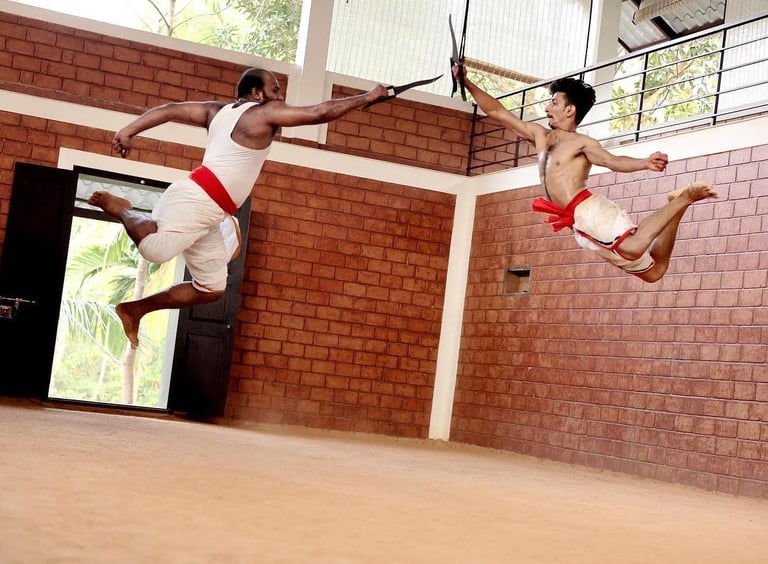
The Northern style is also known as Vadakkan Kalari, and is generally regarded as the "original" form of Kalaripayattu. This system places more emphasis on physical flexibility exercises rooted on the slogan Meyy kannavanam, meaning "make the body an eye". These exercises are done individually, as well as in combinations. After that meypayattu (a concept similar to kata in Karate) is taught. These are a combination of flexibility exercises with offensive and defensive techniques, however, the actual techniques are taught very much later. Traditionally, the number of meypayattu may differ as per the teaching methods of the guru. Training is usually done in four stages, the first stage being Meipayattu (training stances), followed by Kolthari (practice with wooden weapons), Angathari (practice with metal weapons) and finally Verum kai (barehanded combat).Generally, the majority of the Kalaris (schools that teach Kalaripayattu) start training with weapons within 3 to 6 months. Some Kalaris only allow one weapon to be learned per year. After long stick and small stick fighting, iron weapons are introduced. Weapons training begins with the dagger and sword, followed by the spear. Not all modern schools use specialized weapons. Traditionally, bows and arrows were commonly used in Kerala and students were trained in these techniques, but is rarely taught today.
Contact
Reach out to us for classes and queries
Call
+91 9037772778 | +91 9895505852 | +91 9567771279
Copyright © 2025 Daśagrīva School of Kalarippayattu- All Rights Reserved.